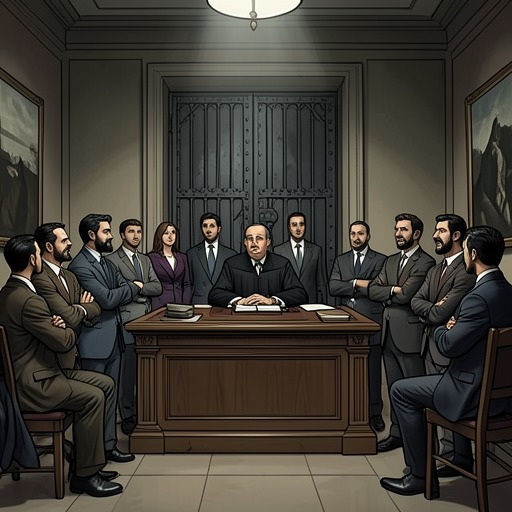
The blade
The Brass VerdictThe blade is Mickey Haller’s metaphor for the disciplined use of a lie exposed in testimony: the defense lawyer waits for a weakness, shapes it into a point of attack, and uses it to open the opposing case. The image links patient listening to forceful advocacy. Across Haller’s encounters with Ronald Torrance and the prosecution of Walter Elliot, it describes not a literal object but a method of finding where an account can be made to yield.
Definition and Method
Haller presents the blade as something made, not simply found. At the defense table, patience comes first: he waits for a lie that can be seized and worked into an instrument precise enough to damage the case built around it. The sequence matters. The lawyer does not begin with indiscriminate attack; he listens until a particular statement offers leverage, then concentrates the examination on that point. The metaphor’s force lies in this conversion of speech into action.
The account also sets a demanding standard for the lawyer using the method. Haller describes the work as forging and sharpening the blade, then applying it without mercy or conscience. That uncompromising formulation presents advocacy as an adversarial craft rather than a neutral search for a complete account of events. His stated role is to offer truth in a setting where everyone lies, but the means he describes are strategic: the defense does not expose every falsehood at once. It waits for the one lie that can reorganize how the rest of the evidence is understood.
Torrance and the Opening in Testimony
Haller explains the method through his effort to draw Ronald Torrance into a long answer. He wants Torrance to keep talking, in contrast to Jerry Vincent, who had successfully prevented that kind of extended response. Haller associates jailhouse informants with con men and professional liars, describing their banter and misdirection as ways of concealing a central deception beneath a mass of words. In that view, verbosity is not merely a nuisance: it can create the conditions in which a revealing inconsistency becomes visible.
During Torrance’s extended answer, Haller notices Jerry Vincent flinch. The gesture confirms to Haller that a detail in the testimony matters, though the cited passage does not specify that detail. He moves closer to the opening and shortly afterward registers that he has caught Torrance. The exchange gives the metaphor its clearest dramatic shape: first comes the lengthy answer, then a small reaction, then Haller’s recognition that the testimony has furnished a point of pressure. The blade is therefore associated not only with attack but with attention to the interval between a witness’s words and another lawyer’s response.
From Witness Examination to the Elliot Case
The same underlying method informs Haller’s account of the prosecution against Walter Elliot, even when the blade is not named. Haller initially acknowledges that he understands the state’s case: it rests on motive and opportunity. In his opening statement, however, he urges the jury to see the prosecution’s elaborate presentation as a complicated construction that fails to establish a case against Elliot. Rather than matching complexity with complexity, he promises to reduce the dispute to the evidence and the reasonable doubt he says it supports. The contrast between a large prosecutorial narrative and a defense effort to isolate its weakness echoes the blade’s function.
Elliot later says that Jerry Vincent had claimed not to need the jury fix because he had The magic bullet and expected to win without a sleeper juror. The remark connects Vincent’s confidence in a decisive piece of evidence with the strategy of finding one element capable of changing the whole case. It does not make The magic bullet identical to the blade: one is described as evidence, the other as Haller’s image for the lawyer’s use of a weakness. Their relationship is structural. Both express the hope that a concentrated point will outweigh the apparent scale of the opposing case.
Evidentiary Pressure and Significance
The gunshot-residue testimony provides a concrete example of how a seemingly damaging fact may be redirected by an alternative explanation. Dr. Shamiram Arslanian describes Walter Elliot being placed, handcuffed, in the back of the four-alpha patrol car, where residue could have transferred to his hands and arms. She further explains a second transfer from those areas to the front of his jacket through ordinary movement, continuing until the clothing was collected. The account supplies a mechanism by which residue on Elliot and his jacket could be explained without treating its presence as proof of the prosecution’s account.
This testimony shows why Haller’s metaphor concerns interpretation as much as contradiction. The defense does not need to make the evidence disappear; it can challenge the conclusion drawn from it by offering a supported account of how it came to be there. The blade’s significance lies in this narrowing of attention: a broad case may turn on one witness’s overextended answer, one reaction noticed at the right moment, or one evidentiary inference that admits another explanation. Haller’s image makes advocacy a craft of selection and pressure, while the recurring gap between the prosecution’s story and a defense alternative leaves the jury to decide which account best fits the facts.